

Most businesses we talk to have already tried AI. They have Copilot licences, a few staff using ChatGPT on the side, and a vague sense that they should be doing more. The problem is not a lack of AI. The problem is that none of it is connected to anything that matters.
Copilot can summarise your emails and draft a Teams message. That is useful. But it cannot look at your CRM, cross-reference a client’s payment history in your accounting system, and flag an at-risk account before your team even opens their inbox. That is the gap between a chatbot and a business AI strategy.
Walk into any office with 20 to 200 staff and you will find the same pattern. A handful of people use ChatGPT or Gemini through personal accounts, pasting in company data with no controls. Others have Copilot but only use it for meeting summaries. Nobody has a policy. Nobody knows what data is leaving the building.
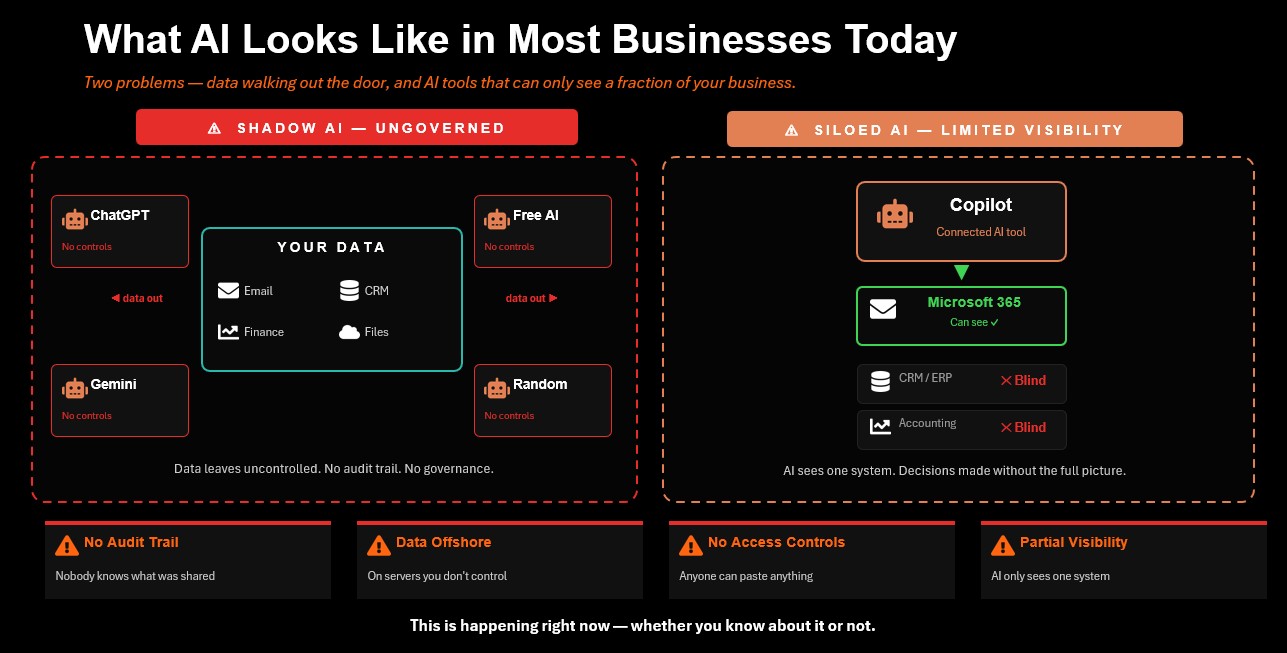
This is shadow AI, and it is one of the fastest-growing blind spots in business technology. A recent BlackFog survey found that almost half of workers are using AI tools their employer has not approved, often on free-tier personal accounts that sit completely outside IT’s visibility. Worse, the majority of senior leaders know about it and are tolerating it because the productivity gains feel too good to question.
We get it. Banning AI does not work. Staff just go underground. But tolerating ungoverned AI is how you end up with sensitive client data sitting in a third-party model’s training pipeline. The answer is not less AI. It is managed AI — AI that is governed, connected, and actually useful across your whole operation.
We are a Microsoft Partner. We deploy Copilot. We think it is a solid product for what it does. But we have been honest about its limitations since we first evaluated it against other models, and nothing has changed our position.
Copilot lives inside Microsoft 365. That is both its strength and its constraint. It can see your Outlook inbox, your SharePoint files, your Teams chats, and your OneDrive documents. If your work happens entirely inside those apps, Copilot works well.
But most businesses do not operate that way. Your client relationships sit in a CRM. Your financial data sits in Xero or MYOB. Your project timelines sit in industry-specific software. Your HR records sit somewhere else entirely. Copilot cannot see any of that. It is an AI assistant with a Microsoft-shaped window on your business, and everything outside that window is invisible.
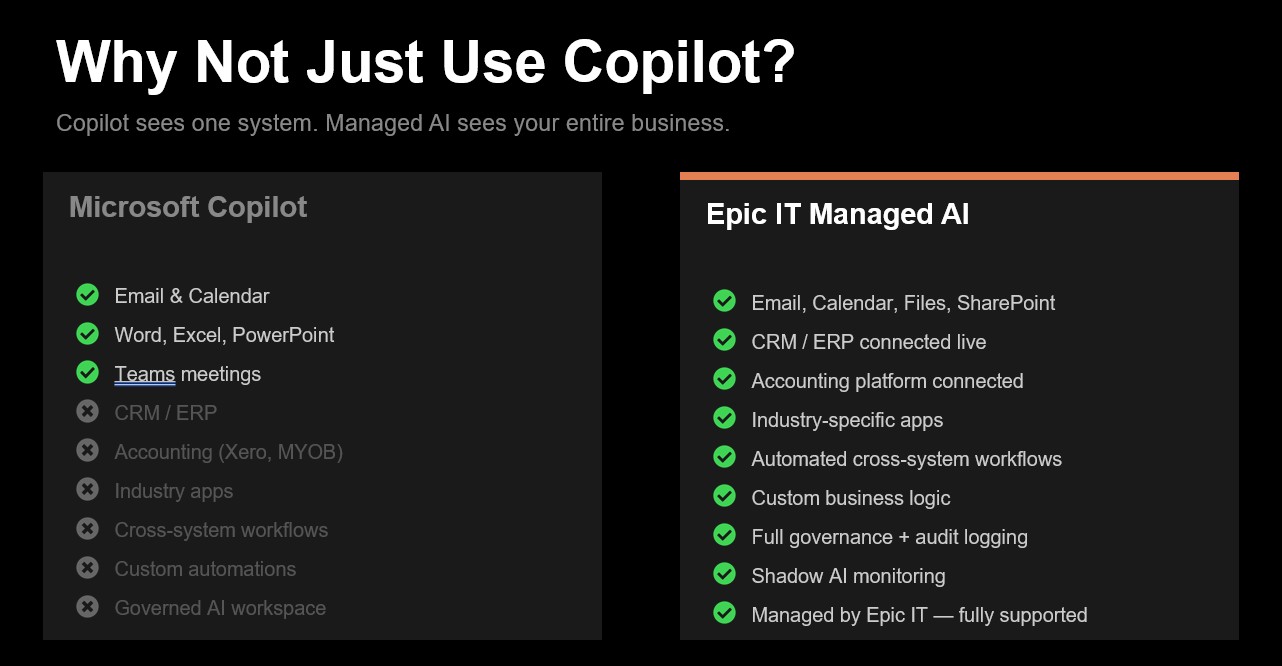
Then there is the governance question. Copilot does not come with an AI usage policy. It does not monitor which other AI tools your staff are using. It does not classify your data or prevent someone from pasting a confidential contract into a free ChatGPT account. Copilot is a productivity tool. It is not an AI governance framework.
The difference between Copilot-only and a managed AI approach is the difference between an assistant who can only read your emails and one who understands your entire business.
Connected AI means an engine that sits securely between your business systems — your CRM, your accounting platform, Microsoft 365, your industry-specific applications — with proper access controls and governance around every connection. It means your AI can answer questions like “Which clients are overdue on their invoices and also have an open support ticket?” because it can see across systems, not just inside one.
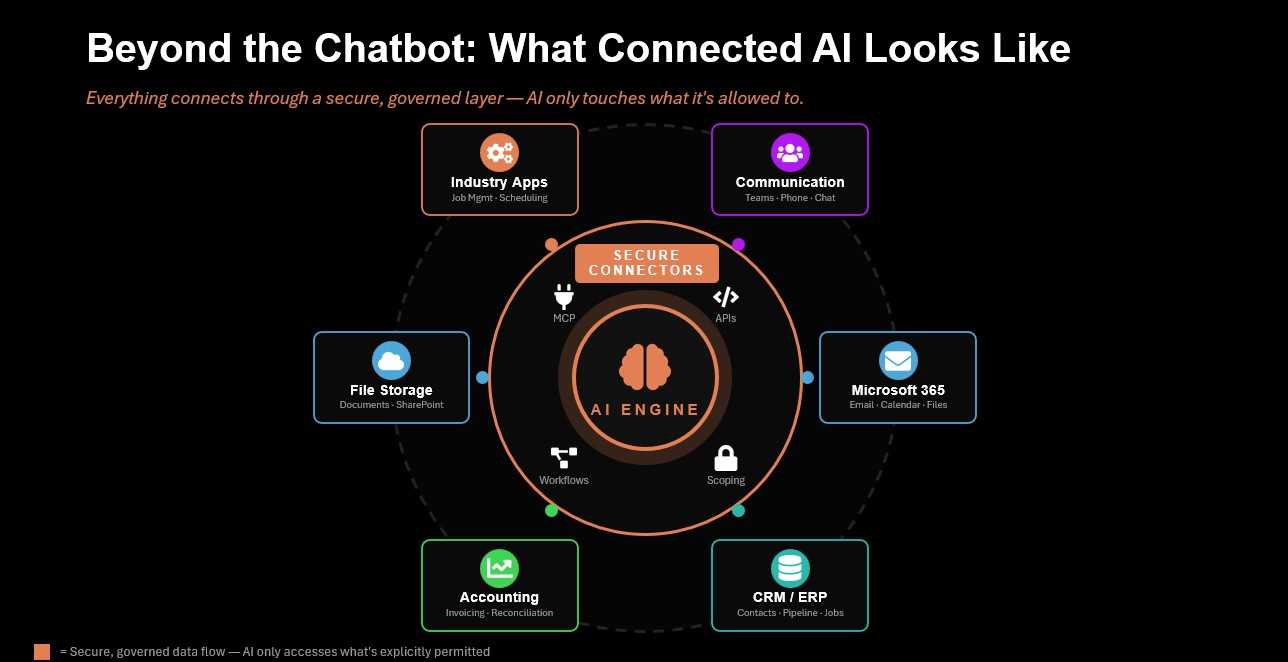
It also means governance is built in from day one. An AI usage policy that staff actually understand. Data classification so your AI knows which information it can and cannot process. Monitoring to catch shadow AI before it becomes a data breach. This is the framework that turns AI from a novelty into a competitive advantage.
We are not being dramatic. The numbers are stark. Organisations with high levels of ungoverned AI usage pay an average of $670,000 more per data breach than those with proper AI governance in place. Annual insider risk costs have hit $19.5 million per organisation, with more than half driven by non-malicious actors — people who were just trying to be more productive.
For a Perth business with 50 staff, a single incident involving client data pasted into an unsanctioned AI tool could trigger obligations under the Australian Privacy Act, damage client trust, and create a compliance headache that takes months to unwind. This is not a hypothetical. It is happening to businesses right now.
Meanwhile, businesses that provide approved, enterprise-grade AI alternatives see unauthorised tool usage drop dramatically. The pattern is clear: give people a better sanctioned option and shadow AI stops being a problem.
We already wrote about why we chose Claude over Copilot as our primary AI engine. That decision still stands. But the model is only one piece of the puzzle.
Our Managed AI service wraps the AI engine in everything a business actually needs to use AI responsibly: secure connectors to your business systems, data governance policies, staff training, usage monitoring, and ongoing optimisation. We handle the infrastructure. You get AI that works across your whole operation, not just your inbox.
The approach is different to buying a Copilot licence and hoping for the best. It is closer to how we deliver managed cyber security — a layered service where the technology is important but the governance, monitoring, and expertise around it are what make it work.
Audit your current AI usage. Ask your team — honestly — which AI tools they are using and what data they are putting into them. You will almost certainly find tools you did not know about. That is not a failure. It is the starting point for doing AI properly.
Write an AI usage policy. It does not need to be fifty pages. It needs to be clear about which tools are approved, what data can and cannot be shared with AI, and what the process is for requesting new tools. Our AI governance page has more detail on what a good policy covers.
Talk to us about a free AI readiness assessment. We will map your current AI landscape, identify risks and opportunities, and show you what connected, governed AI could look like for your specific business. No obligation, no sales pitch — just a clear picture of where you stand. Book your assessment here.
Managed AI is an end-to-end AI service that connects to your entire business — CRM, accounting, Microsoft 365, and industry software — with governance and monitoring built in. Copilot only operates within Microsoft 365. A managed AI approach gives you cross-system intelligence and proper data controls that Copilot alone cannot provide.
Copilot is useful for productivity tasks within Microsoft 365, such as summarising emails and drafting documents. At $30 per user per month on top of your existing licence, it delivers value if your team works heavily inside Outlook, Teams, and SharePoint. But for businesses that need AI to work across multiple systems, Copilot alone will leave significant gaps that a managed AI service fills.
Shadow AI is the use of AI tools by employees without IT approval or oversight. It creates risks around data exposure, Privacy Act compliance, and uncontrolled decision-making. Almost half of Australian workers are using unapproved AI tools at work, often on personal accounts that bypass all corporate security controls.
Copilot costs $30 per user per month as a Microsoft add-on. Managed AI pricing depends on the number of users, systems to connect, and level of governance required. For many Perth SMBs, the total cost of a managed AI service is comparable to rolling out Copilot across the whole team, but delivers far broader capability and proper governance.
Yes. Many of our clients use Copilot for day-to-day Microsoft 365 tasks alongside a managed AI service for cross-system intelligence and governance. The two are complementary. Copilot handles the inbox; managed AI handles the business.